

Having your child start Kindy or School is a huge milestone and naturally evokes many emotions – excitement, nervousness and the feeling that your baby is growing up wayyy too quickly!
We all want our children to transition into school as smoothly as possible. So, CliniKids Speech Pathologist Mikali Kluver shares an acronym to help your little STAR shine at school.
S – Strengths
Parents and caregivers understand their child best, including their unique personality, interests and strengths. The first step to SHINING is to share these strengths and interests with school.
An ‘All About Me’ or a 'My Child cheat sheet' that summarises your child’s strengths can be a way to remove the guesswork for teachers and ensure that your child is understood and celebrated from their first day at school. This may include:
- What your child likes / their interests
- What they don’t like
- How they communicate
- How they regulate / calm
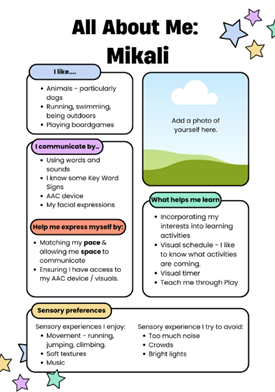
With this information, schools can support learning and engagement by incorporating your child’s interests into activities, using strategies that support regulation and readiness for learning, and interpreting and responding to communication and behaviour unique to your child.
T – Transitions
Transitions are hard. After all, does anyone really like surprises?!
We can support children through the big change that school brings by preparing them for what to expect. It’s important to let your school know what transition supports your child responds to best. Advocate for the use of visual schedules, visual timers, and other supports if needed. Social stories are another wonderful tool to help with this.
A social story is a short, simple story (often with 1 sentence + picture per page) that helps a child understand what may happen in a situation and how they can respond.
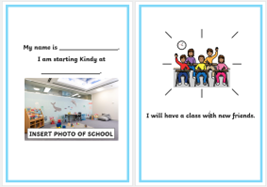
I encourage families to create a social story that includes:
- A photo of the school
- A photo of the teacher
- Examples of daily activities (e.g., mat time, reading, snack, lunch, play time)
Social stories can also:
- Explain what children might be feeling
- Show them who they can ask for help
- Identify safe or quiet spaces they can use
This helps children feel more confident in their ability to understand, manage, and communicate their feelings — and to access support when they need it.
A – Advocate
We want to be sure our children feel confident to communicate as their true self at school — in whatever way that looks like for them.
Communication at school is vital. We want children to be able to advocate for themselves by:
- Asking for help
- Requesting the toilet, food, drink, or a break
- Saying “no” and standing up for themselves
- Sharing their interests and ideas to build relationships
Doing this in a new environment, with new people, can sometimes feel overwhelming.
Support Advocacy:
- Ensure the school understands how your child communicates and that they will respect all forms of communication (e.g., AAC, gestures, Key Word Sign, visuals, etc.).
- Practise key messages at home in real-life situations, as practice really does help build confidence: “I need help”, “I need the toilet”, “I need a break”, “I don’t like it”, “Come play”
- Prepare for moments of overwhelm. Would your child benefit from visual supports to help them communicate when they’re feeling nervous or dysregulated? If your child is a visual learner, ask whether the school can provide visual supports to support their understanding.
- Encourage collaboration between the school and your child’s therapy team (e.g., speech pathologist, OT, physio). Ask for a meeting, share goals, and work together — collaboration is key to ensuring consistency and positive outcomes.
R – Regulation
The first day of school is bound to bring up feelings of excitement, as well as apprehension. Separation from our loved ones is hard! Furthermore, Kindy and Pre-primary place new demands on children that they have not experienced before; including longer hours and more days, structured learning activities, an adult-led schedule, a brand-new environment to navigate, and new peers and new adults to build trust with.
Not surprisingly, there are going to be moments of dysregulation for your child – moments where they feel overwhelmed and have trouble controlling their emotions or behaviour.
The first step is to acknowledge your child’s emotions to help them feel understood. Secondly, ensuring access to regulation supports is going to be vital for success. Talk to your school about the regulation strategies they have available and what options your child may enjoy. Some examples may include time outside, movement breaks, a quiet, dim space for decompression, inside sensory supports – egg chair, trampolines, body socks or noise-cancelling headphones.
It is also important that caregivers hold space for their child whilst they adjust to these new demands. Expect your child to be more tired and more emotional after school. Building in quiet decompression time after school can be incredibly helpful. Allowing space for free play and simply letting your child be a child may be especially important during this transition period
Final thoughts:
Starting school is a big step for children and their families. Remember, the first term isn’t focused on academics. It is all about feeling safe, building trust and learning the routine of school. We can use the STAR framework to support our children with this transition and to help them shine their brightest at school.
First published Friday 30 January 2026.
View all news articles